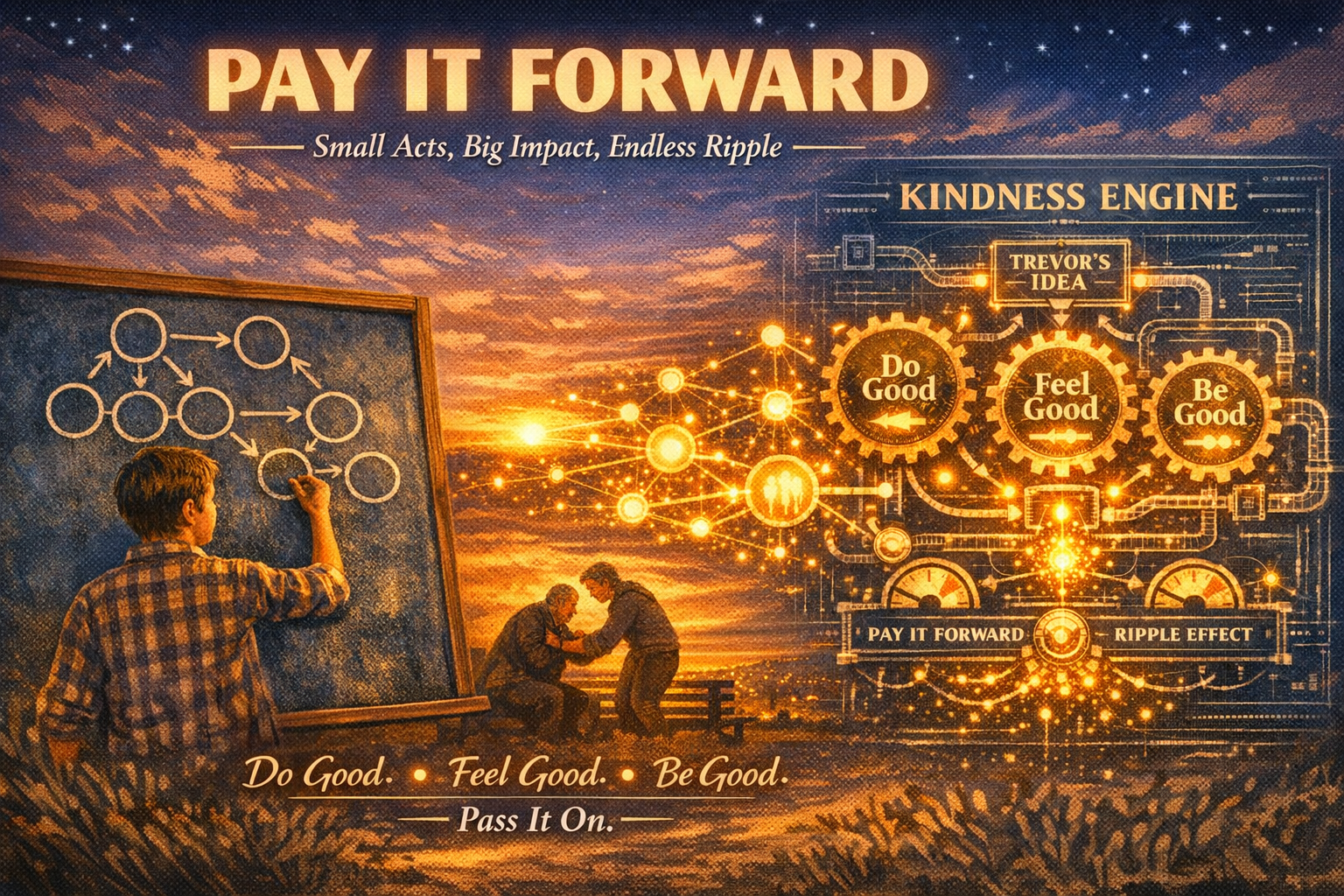
Pay It Forward — Kindness Engine
Small Acts, Big Impact, Endless Ripple
Some movies entertain you.
Some movies distract you.
And then there are the rare ones — the ones that slip under your skin and quietly rearrange the architecture of who you become.
For me, Pay It Forward was one of those.
Not because it was perfect.
Not because it was polished.
But because it dared to ask a question most adults are too tired or too cynical to ask:
“What would it take to change the world?”
A seventh grader answered it.
And his answer was so simple, so human, so disarmingly sincere that it felt like a blueprint for something bigger than the film ever had the chance to explore.
Trevor McKinney didn’t pitch a startup.
He didn’t write a manifesto.
He didn’t wait for permission.
He drew circles.
Three circles.
Then three more.
Then three more.
A geometric explosion of kindness.
A child’s sketch of a world that could be.
It was the first time I saw a movement on screen before I even had the language for what a movement was.
And it planted a seed I didn’t realize would grow into the core of my life’s work.
Because the truth is:
Do Good Feel Good Be Good is a pay‑it‑forward network.
A modern one.
A resilient one.
A human one.
Trevor’s idea was the prototype.
What we’re building now is the evolution.
Trevor’s Assignment, Reimagined for a New Generation
In the movie, Trevor’s teacher gives the class an impossible assignment:
“Think of an idea to change the world… and put it into action.”
Most kids shrugged.
Most adults would too.
But Trevor didn’t.
He believed — stubbornly, irrationally, beautifully — that people were good.
He believed they just needed the right invitation.
He believed kindness could spread the same way fear spreads: through contact.
He wasn’t wrong.
He was early.
If Trevor were alive today, staring at that same impossible prompt, I think his answer would look a little different — not because his idea was flawed, but because the world has changed.
People are exhausted.
Attention is fractured.
Everyone feels like they’re carrying too much.
So here’s the modern version of Trevor’s assignment — the one built for our world, our pace, our emotional bandwidth:
**Do one small good thing for a few people.
Let it ripple.
Let it be enough.**
No heroics.
No pressure.
No grand gestures.
Just a moment of humanity.
A spark.
A reminder that we’re still connected.
Trevor drew circles of three.
You can draw circles of one.
One person you help.
One moment you brighten.
One kindness you choose on purpose.
And if they pass it on — even once — the circle grows.
Not because you demanded it.
But because kindness feels good.
Because goodness wants to move.
Because humans are wired to mirror what they receive.
This is the heart of Do Good Feel Good Be Good.
Not a movement of heroes.
A movement of humans.
The Physics of Contagious Kindness
Some forces in the world are loud.
They announce themselves.
They demand attention.
They bend history through shock and spectacle.
But kindness is different.
It’s quieter.
Older.
More subversive.
Not the sentimental version.
Not the Hallmark version.
I mean the real thing:
The kind of kindness that interrupts despair.
The kind that alters someone’s emotional trajectory.
The kind that spreads because it feels too good not to.
A single act of kindness is never just a moment.
It’s a signal.
It tells someone:
You matter.
You’re seen.
You’re not alone.
The world is not as cold as it felt five minutes ago.
And humans — beautifully, predictably — respond to that signal.
We mirror what we receive.
We pass on what we’re given.
We become conduits for the emotional energy that touches us.
This is why one small act can ripple outward in ways you never see.
You hold a door.
Someone else softens their tone.
Someone else forgives a mistake.
Someone else calls their mother.
Someone else decides not to give up today.
You didn’t just hold a door.
You altered the emotional climate of a stranger’s life.
That’s the physics of it.
Kindness doesn’t need heroes.
It needs participants.
Not perfection.
Intention.
Not three big acts.
One small one.
Repeated.
Shared.
Passed on.
This is why Do Good Feel Good Be Good works.
It’s not a movement of extraordinary people.
It’s a movement of everyday people doing ordinary things on purpose.
And ordinary things, done consistently, become extraordinary over time.
The HumanKind Manifesto (Inspired by a Boy Who Believed in Us)
There’s a moment in Pay It Forward that stays with you long after the credits roll.
A boy — small, quiet, unarmored — stands in front of his class and explains a plan so simple it feels impossible:
“You do something really good for three people.
They do something really good for three people.
And it keeps going.”
This manifesto is the continuation of that belief.
The grown‑up version.
The modern version.
The resilient version.
The version built for a world that desperately needs it.
1. We Believe People Are Good — Not Perfect, But Good
Most people are carrying more than they show.
Most people are trying harder than they admit.
Most people want to be kind — they just need the right moment, the right invitation, the right spark.
We choose to believe in that goodness.
We choose to design for it.
We choose to amplify it.
2. Small Acts Change More Than Big Ones
Big gestures are beautiful, but they’re rare.
Small kindnesses are everywhere — and they scale.
A smile.
A pause.
A moment of patience.
A compliment you didn’t have to give.
These are not small things.
These are the building blocks of a better world.
3. Kindness Is Contagious — Let It Spread
Every act of kindness is a signal.
Every signal becomes a story.
Every story becomes a ripple.
You never know who needed that moment.
You never know what it prevented.
You never know what it inspired.
But it moves.
It always moves.
4. We Don’t Need Heroes — We Need Participants
You don’t have to save the world.
You don’t have to fix everything.
You don’t have to be extraordinary.
You just have to show up.
You just have to care.
You just have to do one small good thing — and trust it to ripple.
Movements aren’t built by heroes.
They’re built by humans.
5. We Are Building a Network of Goodness
Do Good Feel Good Be Good is not a slogan.
It’s a system.
A practice.
A culture.
A way of moving through the world.
It’s Trevor’s idea — evolved.
Not three big acts.
Just one small act, repeated.
By many.
Every day.
Everywhere.
A pay‑it‑forward network for the modern world.
A kindness engine.
A human-powered ripple machine.
6. This Is How We Change the World
Not through force.
Not through fear.
Not through perfection.
Through participation.
Through intention.
Through contagious kindness.
One moment at a time.
One person at a time.
One ripple at a time.
This is the movement.
This is the invitation.
This is the lantern we’re building together.
Trevor lit the match.
We carry the flame.
Do Good — Feel Good — Be Good
Pass it on.

0 Comments